
Skip to content
FRESH EARTH UNIVERSE · VOLUME IEDITED BY FRESH EARTH STUDIO · 2026

Five chapters on owning the land
that’s healing the planet.

One subject, five voices, sixty dispatches. A coordinated publication on regenerative finance as an asset class — each chapter a complete read in its own register, the volume more than the sum of its parts.

Enter Volume IOr read the story in 5 minutes

§ THE DOORS · CURRENT WORK

Seven first-experience doors. Stranger, parent, ambassador, institution.
Ownership of healed land — not just for big funds anymore.

The latest canon — seven storyboards explaining Fresh Earth, each tuned to a different reader. Seven farms owned, restored, operating. The fund is opening so anyone can own a piece.

Open the seven doors →
WHAT WE ARE BUILDING

§ NOTE FROM THE EDITOR

One thesis. Five rooms. The argument that working farmland is becoming an ownable asset class cannot land in every kind of room in the same voice. A contemplative reader, a system architect, a chair of an investment committee, a writer, an accomplice — five different kinds of attention. We refused to compress them into one.

Volume I is the result. Five chapters in five distinct registers, twelve dispatches each, sixty in total — released as a single coordinated publication. Each chapter is a complete read.

The argument is the same; the language is yours. If you only have ten minutes, begin with Chapter V — The Movement. If you came for the photograph, begin with Chapter I — Own change. If you sit on a committee, the specimen pages of Chapter III do the work.

— FRESH EARTH STUDIO · CREATIVE DIRECTION

§ THE FIVE CHAPTERS

  1. CHAPTER I · EDITORIAL · PHOTOGRAPHIC · MUSEUM-MOUNT

    Own change

    For the contemplative.

    In the lineage of Penguin Modern Classics and Aperture’s long-form essays. Twelve photographic dispatches in cream margin: hand-grade earth photography held away from type, the argument breathing in the air around the image. The reader leaves Chapter I trusting the work the way they trust a museum.

    READ CHAPTER I
  2. CHAPTER II · DIAGRAMMATIC · WOODCUT · WHOLE EARTH

    Library of blueprints

    For the system reader.

    In the lineage of the Whole Earth Catalog and the working-drawing tradition. Twelve hand-cut SVG plates: how the protocol works, how the network compounds, how trust holds. Each plate is a how-this-works, not a hero shot. The reader leaves Chapter II able to draw the system from memory.

    READ CHAPTER II
  3. CHAPTER III · SPECIMEN · INSTITUTIONAL · STRIPE PRESS

    The most valuable currency

    For the chair of an investment committee.

    In the lineage of Stripe Press and the Bloomberg Green specimen pages. Twelve dispatches read like an investment memo: chart primary, prose serving the numbers, footnotes earning their seriousness. The chair takes Chapter III into the meeting and the page does the work.

    READ CHAPTER III
  4. CHAPTER IV · EDITORIAL · INSTITUTIONAL · LEDGER-OBJECT

    Letters from the field

    For the writer.

    In the lineage of the New York Review of Books and Harper’s Letter From. Twelve diptych spreads — a ledger object on the left (a stamped certificate, a steward’s letter, a verifier’s signature) and quiet reportage on the right. The same closing line as Chapter V’s poster, but here as a steward’s letter. The reader leaves Chapter IV trusting language as evidence.

    READ CHAPTER IV
  5. CHAPTER V · TYPOGRAPHIC · POSTER · JUSTIFIED DECLARATION

    The Movement

    For the accomplice.

    In the lineage of Werkplaats Typografie and Dutch concrete poetry. Twelve posters in justified, drop-capped Newsreader, every line filling the measure. The same closing line as Chapter IV — but here as a wall. The shortest read of the five, and the strongest by our review. Chapter V is the one you remember after closing the laptop.

    READ CHAPTER V

§ THE COMPANION VOLUME

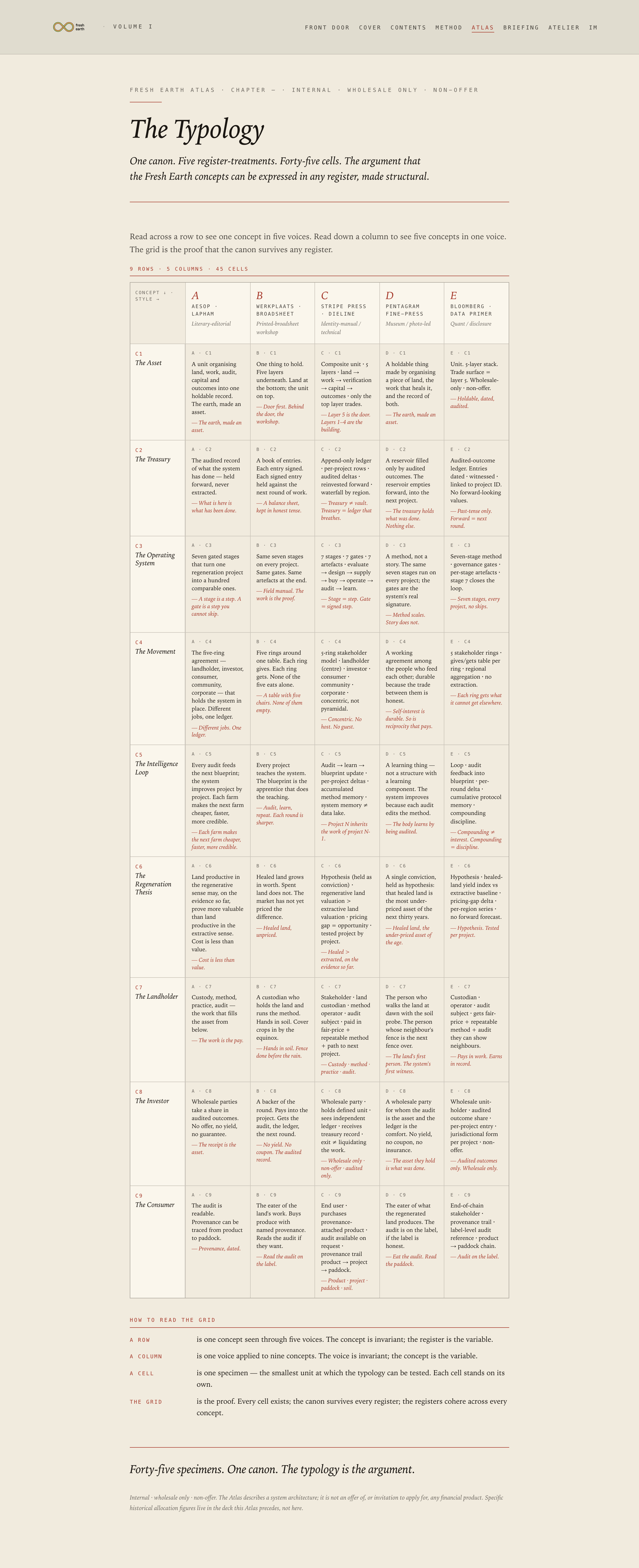
The Atlas runs alongside the five chapters. Where each chapter argues, the Atlas explains: nine concepts, five register-treatments, one canon. Read it before the chapters, between them, or after — it stands on its own.

COMPANION · TYPOLOGY · NINE CONCEPTS · FIVE STYLES

The Concept Atlas.

For the curious. For the reader who wants the parts before the argument.

Five chapters of editorial reading; five register-treatments of the same nine concepts; six special pages — typology grid, named verification standards, single-broadside manifesto, worked first-project specimen, A1 poster, ninety-second plain read. The conceptual foundation the chapters and the IM stand on.

OPEN THE ATLAS →

§ SUGGESTED WALKS

IF YOU HAVE TEN MINUTES

Open V — The accomplice. The shortest read. The argument arrives on a single page.

IF YOU SIT ON THE COMMITTEE

Open III — The most valuable currency. The specimen pages do the work; bring the IM for the rest.

IF YOU CAME FOR THE PHOTOGRAPH

Open I — Own change. The argument lands on the image. The other four chapters can wait.

IF YOU HAVE THE WHOLE EVENING

Walk V → II → III → IV → I. End on photography, then read the Contents and follow one theme back across all five.

§ THE APPARATUS

COVER STRIP

Five rhyming covers as one strip. Pick the chapter that suits the reader.

OPEN COVER STRIP →
CONTENTS

Sixty dispatches, twelve themes, cross-referenced across all five chapters. Plus reels and print downloads.

OPEN CONTENTS →
NOTES ON METHOD

A studio working method — drafted, reviewed by senior eyes, signed off externally. Sixty dispatches, one volume.

READ THE METHOD →
ATELIER

Behind the volume — the doctrine, the studio's review committee, the rounds of external sign-off, the revisions and the lessons.

STEP INTO THE ATELIER →
INFORMATION MEMORANDUM

The underlying business document. Sixteen sections, every number, every gate. Wholesale only.

OPEN THE IM →
FIRST CLOSE A$1,000,000 · TARGET Q2 CY26 · luke@freshearth.io
WHOLESALE INVESTORS ONLY · S708(8)/(11) · RG 170 · CAPITAL AT RISK · READ THE IM
— FRESH EARTH STUDIO · EDITORIAL DIRECTION OF VOLUME I · 2026-04-29